We’ve Got Your Back. Double-Dip with a Double Feature.
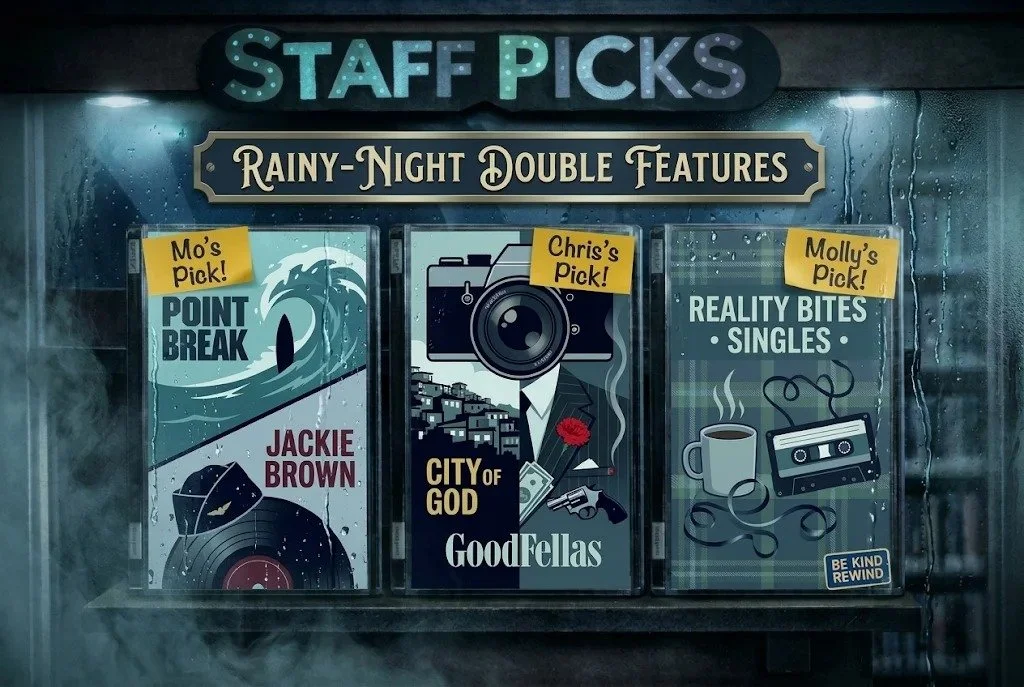
The forecast calls for rain. Your plans have been canceled. Leaving the house would require effort, dry socks, and a willingness to interact with other people.
Fortunately, the Video Garden staff has prepared three double features capable of rescuing your weekend.
Mo’s challenge remains the same:
Choose two movies and sell the pairing in five hundred words or less.
The movies should complement each other without feeling repetitive. The second should make the first more interesting. And if anyone falls asleep before the closing credits, the recommendation is automatically disqualified.
Two movies. One rainy night. No wasted rentals.
——————————————————————————————————————————————————————————————————————————————————————-
MO’S DOUBLE FEATURE
Point Break and Jackie Brown
Best for: Anyone who wants filmmakers with something to say and enough confidence to entertain you while saying it.
Auteurs have been unfairly accused of making movies that feel like homework.
Kathryn Bigelow and Quentin Tarantino prove otherwise.
Start with Point Break, a movie about an FBI agent infiltrating a gang of bank-robbing surfers that somehow becomes a hypnotic study of obsession, identity, and the seductive power of absolute freedom. Keanu Reeves plays Johnny Utah, a former quarterback whose name alone should have earned the film an Academy Award. Patrick Swayze plays Bodhi, a philosopher in a wetsuit who robs banks, chases storms, and refuses to accept that ordinary rules apply to extraordinary people.
Bigelow gives you foot chases, surfing, skydiving, and one of the most emotionally complicated bromances ever disguised as an action movie. You may arrive for the bank robberies. You will stay because Johnny Utah no longer knows whether he wants to arrest Bodhi or become him.
Then move to Jackie Brown.
Tarantino slows everything down and gives the screen to Pam Grier, who plays a flight attendant trapped between a gunrunner, the police, and a future that seems to be disappearing in front of her. Jackie survives because everyone underestimates her. She watches. She waits. Then she quietly becomes the smartest person in the room.
Robert Forster’s Max Cherry understands almost immediately. Their restrained connection gives the movie its soul. No grand speeches. No manufactured fireworks. Just two adults recognizing something rare in each other while time keeps moving.
These movies appear to have little in common. One races toward the next adrenaline rush. The other knows the most dangerous person in the room may be the one who remains perfectly still.
Together, they remind us what great filmmakers do. They take familiar genres, find the humanity buried inside them, and leave you thinking long after the entertainment has done its job.
Mo’s closing argument: Bigelow gives you the wave. Tarantino gives you the undertow. Either way, surrender to the current.
CHRIS’S DOUBLE FEATURE
City of God and Goodfellas
Best for: Anyone who wants the crime genre at its most exhilarating, brutal, and unforgettable.
If you are giving an entire evening to crime movies, do not waste it on respectable second choices.
Start with City of God.
Set in the favelas of Rio de Janeiro, the movie follows Rocket, a kid trying to become a photographer while everyone around him is being pulled deeper into violence. He understands the rules of his neighborhood, but he does not want those rules to determine the rest of his life.
The movie moves like it has somewhere urgent to be. Characters appear, disappear, collide, and return changed. Every act of violence creates another debt. Every child watches someone older and learns the wrong lesson. Rocket survives by observing everything, finding the frame, and recognizing that telling the story may be his only way out of it.
Then watch Goodfellas.
Henry Hill does not want out. From the moment he sees how gangsters command a neighborhood, he wants in. The clothes, the money, the nightclubs, the respect. Martin Scorsese makes the life look intoxicating because it has to look intoxicating. Otherwise, nobody would surrender everything to join it.
Then the glamour curdles.
Friends become liabilities. Loyalty becomes paranoia. Every favor comes with a price, and every celebration moves the characters closer to the inevitable consequences.
That is why these movies belong together. Both immerse you inside criminal worlds without pretending those worlds are sustainable. Rocket spends his life resisting the current. Henry willingly dives into it. One discovers how to turn observation into escape. The other realizes too late that the life he worshipped was always going to consume him.
They are fast, funny, frightening, and nearly impossible to look away from. More importantly, they understand that crime stories are never only about crime. They are about belonging, ambition, power, and the stories people tell themselves to survive their choices.
Chris’s closing argument: Watch one young man fight to escape the life around him, then watch another spend everything he has trying to get inside.
MOLLY’S DOUBLE FEATURE
Reality Bites and Singles
Best for: Anyone who remembers when adulthood arrived without instructions, reliable employment, or Wi-Fi.
Gen X is the generation movies almost forgot about.
Everyone remembers the music, flannel, coffee shops, and aggressively casual hair. Fewer movies remember what it actually felt like to become an adult after being promised that intelligence and authenticity would eventually lead somewhere.
Start with Reality Bites.
Winona Ryder plays Lelaina, an aspiring filmmaker with talent, ambition, and no idea how to translate either into rent money. Ethan Hawke plays Troy, who has transformed emotional unavailability into an entire belief system. Ben Stiller represents achievement, stability, and the terrifying possibility that adulthood may require compromise.
Nobody has everything figured out. That is the point.
The movie understands the particular panic of believing you were destined for something meaningful, then discovering the world has no immediate opening for whatever that is.
Next comes Singles.
Cameron Crowe trades Houston for Seattle and widens the lens. Instead of following one group trapped between ambition and adulthood, he builds an entire apartment complex full of people trying to connect without admitting how badly they need one another.
There are musicians waiting to be discovered, professionals pretending their plans are working, and people who would rather explain love than risk experiencing it. The soundtrack is excellent. The clothes are better. Nobody communicates efficiently.
Together, these movies preserve a generation caught between analog intimacy and corporate adulthood. They are romantic without trusting romance, cynical without surrendering hope, and funny because almost everyone recognizes that their carefully constructed identity is held together with mixtapes and denial.
Still awake? Add Noah Baumbach’s Kicking and Screaming as a nightcap. It is the deep cut for anyone willing to spend a third movie with recent college graduates who cannot move forward because overanalyzing their lives feels safer than living them.
Also, the title describes exactly how Mo reacted when I suggested three movies instead of two.
Molly’s closing argument: Come for the flannel. Stay because an entire generation deserves better than being remembered as a soundtrack and a haircut.
CHOOSE YOUR RAINY-NIGHT LINEUP
Which double feature are YOU taking home?
